About Drake

This author has not yet filled in any details.
So far Drake has created 2061 blog entries.

Rio Lobo – 1970 Hawks

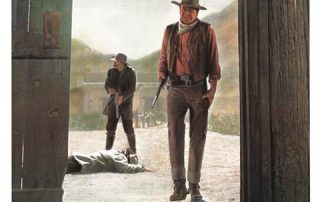
The final film of Howard Hawks (at the age of 74) is certainly one of his lesser works, and the least of the five John Wayne collaborations (four of them westerns including Red River, Rio Bravo, El Dorado). It brings back screenwriter Leigh Brackett, and there is talent here in the music as well (Jerry Goldsmith). Instead of getting Robert Mitchum to return from El Dorado, they cast his son. Jonathan Rosenbaum was one to point out that one of the most inspired sequences in the film (the opening train action set piece- the clever little hornet heist) was

Rio Lobo – 1970 Hawks2021-10-02T13:29:45-04:00

The Bird with the Crystal Plumage – 1970 Argento

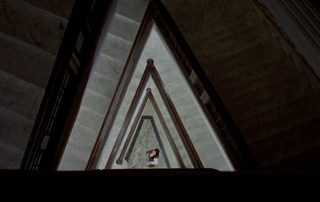
  The Bird with the Crystal Plumage is the auspicious debut for first time director Dario Argento. It marks quite the meeting of talented Italians with Argeno (thirty at the time) working with cinematographer Vittorio Storaro (also thirty, his first color film, and this was the same year he worked with Bertolucci on The Conformist) and Ennio Morricone (an unnerving score using some vocalizations). It is an important film in the Giallo subgenre (there was a sort of post-Spaghetti Western boom about to happen). Yet, this is also clearly tied to the successful Italian import Blow-Up from Antonioni in

The Bird with the Crystal Plumage – 1970 Argento2021-10-02T12:52:09-04:00

Somebody Up There Likes Me – 1956 Wise

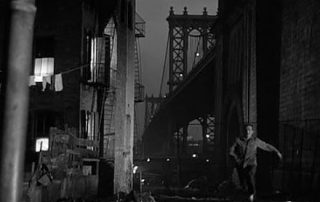
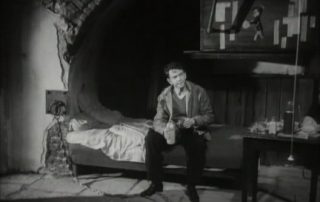
Somebody Up There Likes Me is a biopic of the dramatic life of boxing great Rocky Graziano. It even bears Rocky’s signature before the opening credits (which has the great Perry Como crooning over them with the title song). Parts of it were shot in New York and that is a key choice from Robert Wise. When Paul Newman’s Rocky is walking down the street (there is a longer take early with Sal MIneo) it is clear that this is no studio lot. The film is best known now as the coming out role (or rather part of his

Somebody Up There Likes Me – 1956 Wise2021-12-09T11:49:17-05:00

The Hidden Room – 1949 Dmytryk

The Hidden Room is a delightful England-set (Dmytryk abroad for the HUAC fall out- he was part of The Hollywood Ten) noir with an ingeniously little sinister premise and an early score from Nino Rota. Robert Newton plays Dr. Clive Riordan who catches his wife Storm (an amazing name for a British woman in 1949) (played by Sally Gray) stepping out with Bill Kronin (Phil Brown). Riordan is plotting his revenge as the film opens and there is this small talk going on in the background at his gentleman’s club (the uppity kind country club kind of gentleman’s club—not

The Hidden Room – 1949 Dmytryk2021-10-01T21:41:44-04:00

School Daze – 1988 Spike Lee

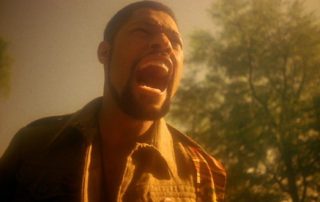
School Daze does feel like a half step back from She’s Gotta Have It (Spike Lee’s debut in 1986). Spike’s second film has no shortage of ideas though, it is an ambitious work, and undoubtedly auteur cinema. It is set on a HBCU (Historically Black College) campus. Lee, who often starts or ends his films with documentary footage (Malcolm X, BlacKkKlansman) starts with a montage of black heroes immortalized in black and white photographs. It opens on Friday- the story of the homecoming weekend at the college. Lee’s film takes more swings than it lands. It is full of

School Daze – 1988 Spike Lee2026-01-16T07:21:59-05:00

Executive Suite – 1954 Wise

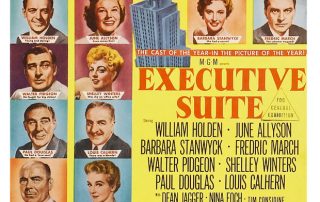
1954 is post-Lady in the Lake (1946) and Dark Passage (1947) but the first-person point of view sequence to open Executive Suite is still stirring. The hand of Avery Bullard (never shown on screen) reaches out from behind the camera to shake hands. He pushes the button on the elevator in one smooth take after gliding across the room. Robert Wise hides a cut (editor of Citizen Kane) going in the elevator as the camera pushes through the door reaching for his wallet at the telegraph office. On the street (still in this same cinematic sequence) he yells for

Executive Suite – 1954 Wise2026-01-04T11:50:00-05:00

1999

best film:  Magnolia from Paul Thomas Anderson Magnolia leads the pack for 1999- which is a superb and incredibly deep year in cinema history.  Magnolia proved Boogie Nights was no fluke. It also showed that Paul Thomas Anderson is as beholden to Altman as he is to Scorsese, and that he is perhaps the greatest director of his generation.  It is sheer filmmaking confidence and ambition with an ensemble to rival Nashville (which Altman made at the age of 50).  It is a very big film. Ebert called it “operatic ecstasy” https://www.rogerebert.com/reviews/great-movie-magnolia-1999 and PT Anderson said (at the time) 

19992022-03-21T22:55:10-04:00

Body Double – 1984 De Palma

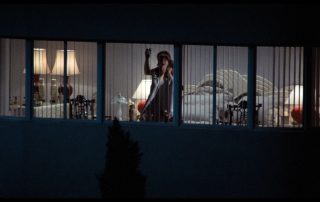
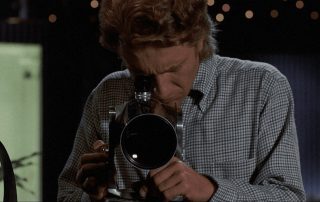
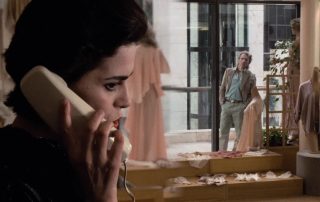
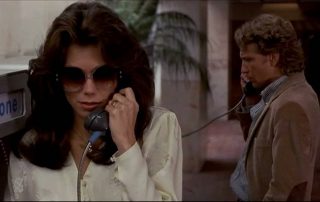
Brian De Palma taps into both Rear Window and Vertigo for his 1984 film Body Double Body Double is one De Palma wrote as well as directed- unlike Scarface, Carrie, The Untouchables. Like Blow Out, it opens on the making a movie- a B-movie- a horror movie. Jake (Craig Wasson) is playing a vampire and his claustrophobia (akin to Vertigo) acts up. Jake struggles to find work, needs a place to stay, and ends up getting a temporary job/home housesitting at the “Chemosphere”- a crazy modern spaceship-looking house off Mulholland built by John Lautner in 1960. Like Rear Window,

Body Double – 1984 De Palma2021-09-20T16:29:24-04:00

Arlington Road – 1999 Pellington

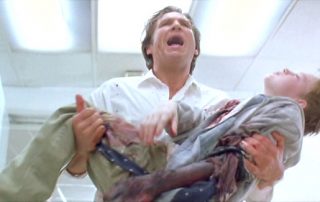
Arlington Road is an impressive little terrorism thriller featuring Jeff Bridges (one year off Big Lebowski) pitted against an eerie Tim Robbins. Mark Pellington is the director. Pellington is best known for music videos by Springsteen, Jon Bon Jovi and others. Pellington opens the film with great energy. Before the opening credits, Bridges (playing Michael Faraday) discovers the son of Robbins’ character (Oliver Lang) in the middle of the street in immense pain from a fireworks accident. Pellington uses a washed-out dissolve heavy soft focus for this sequence (above). The Faradays and Langs are neighbors. The sons and fathers

Arlington Road – 1999 Pellington2021-10-19T12:57:06-04:00

Blow Out – 1981 De Palma

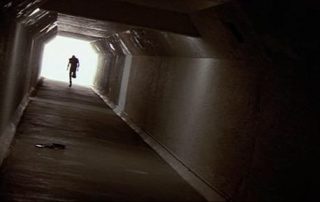
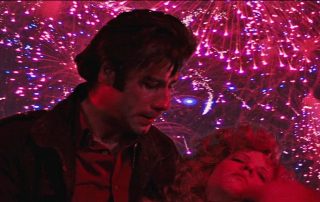
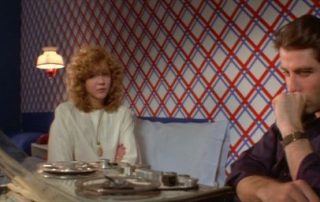
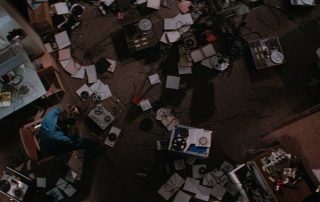
Can you imagine how this must have sounded in 1980? Brian De Palma is remaking/updating Antonioni’s Blow-Up? but calling it “Blow Out” about a tire blow out- hahaha. Blow Out may not only be worthy to Antonioni’s film- but surpass it. And it is by all accounts the De Palma film where just about everything work out swimmingly—technical prowess, a riveting story-- sonic boom-level cinematic virtuoso flourishes aplenty. The film opens with a point of view Steadicam tracking shot (run by Garret Brown- the Steadicam inventor who worked on Bound for Glory, Rocky, Marathon Man and… yes.. The Shining).

Blow Out – 1981 De Palma2021-10-17T15:00:41-04:00

Blood on the Moon – 1948 Wise

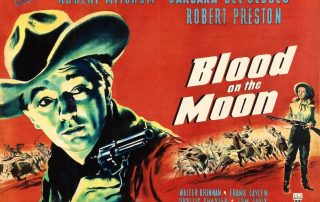
It is not the first (probably musicals), second (science fiction), third (noir) or even fourth (war films) genre most often associated with Robert Wise- but Blood on the Moon is a rock solid western. It kind of makes you wish he had done more (as far as I can tell- it is his only one). He made it at RKO in 1948. It stars Robert Mitchum (his first western in the archives), Robert Preston (a stout figure, charismatic- and good enough an actor to go toe to toe with Mitchum) and a nice supporting role for the always reliable

Blood on the Moon – 1948 Wise2021-10-16T14:49:55-04:00

Election – 1999 Payne

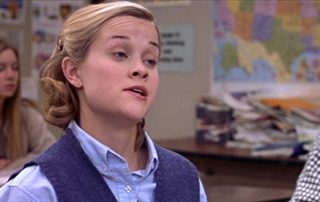
Citizen Ruth (1996) is a solid debut- but Election marks the announcement of a promising talent in American cinema in Alexander Payne. Like Citizen Ruth, About Schmidt, Nebraska and Downsizing- it is set in Payne’s native Nebraska. The high school genre and teen film was still fertile ground in 1999 (Reese Witherspoon is in a few of these herself including the wickedly fun Cruel Intentions from the same year) but Election is a teen film going for more. The casting of ex-teen film god Matthew Broderick (Ferris Bueller himself from Ferris Bueller’s Day Off- 1986) feels like an acknowledgement

Election – 1999 Payne2021-11-19T11:55:03-05:00
Go to Top